Tallinn to Germany by train, mostly
2023-06-14
I somehow came up with the idea of studying in Estonia. I also really enjoy train travel. So, naturally I felt the urge to cover the distance between my hometown in Germany and Tallinn, the Estonian capital, by train. Having looked at the available options for doing so I found that this wouldn't be easy, at least not yet. So, instead of on rail, I have since traveled by ferry, taking my bicycle along, and by coach, as a quick and cheap option for the short break in winter. Nearing the end of May this year I found myself with no more exams to attend and a good chunk of time to spend traveling, as well as some money to spare to splurge on accommodation. Having made the journey I thought I might as well document what it was like, to give others an idea and have a reference for when Rail Baltica finally completes.
Getting out of Estonia
Getting out of Estonia by train already isn't exactly trivial. There is one connection a day, in the border town of Valga/Valka. But I am getting ahead of myself.
The one train that makes the connection in Valga leaves Tallinn at roughly 07:30. Thanks to Estonian time tables in the university, I usually still sleep or at least avoid getting up at this time. Knowing that going to sleep means risking missing the train entirely, setting my entire journey back by a day before it even started, I made the only reasonable decision to just not go to sleep the night before. Instead I would spend the gained time packing my belongings, very generously, and surprisingly also fixing my boot loader. This is sure to keep you awake.
With the adrenaline of scrambling to get my laptop in a usable state again having mostly passed I grabbed my backpack and left the dormitory, heading for the bus station. This is a train trip, why are you taking the bus?!? There are two train stations within comfortable walking distance of where I live, but none of them are served by the train I needed to take. One because it lies on a different branch of the network, and the other because it is not worthy of an express train. So instead, my first itinerary was Tallinn's main station, often referred to as Balti jaam, or Baltic station. If the reader knows Tallinn, or practices the art of figuring out where people live, based on the information they throw onto the interwebs, they will know that the bus passing by my home does not stop at Balti jaam. Instead it stays on the other side of the old town and terminates there. While I could have walked a bit further to catch a more frequent bus which would have directly gotten me there, this would have been no fun. Instead I chose to walk through the old town and planned 40 minutes for this supposed 20 minute journey.
Tallinn old town is beautiful. "Old" is not an overstatement. Think of the magical shopping alley of a certain wizardry universe. There is a significant difference however, obfuscated for the uninitiated: There is a hill. Part of the old town is situated on top of which, with most of it lying to the east. The northern side of said hill is rather steep, with stony staircases zigzagging down the side. My walk could be classified as a short hike, as it started with climbing up the hill from the freedom square and ended with following the stairs back down on the other side. In between this I walked on bumpy, narrow, cobbled streets and dodged the barriers put in place, presumably for the Baltic and German heads of government who were scheduled for a visit that very day.
I had been up there before, when I first got to Tallinn, the previous summer. Once I reached the top I thought, looking at the map on my phone, "I'll just walk over there and then take the stairs." The stairs where no where to be found, with the map instead leading me into corners with "Private property" written on them. I generally try to not be the kind of tourist who disregards any inconvenient sign, and so I backed out of that little street. Thinking back to my first visit up there, this private property sign was close to the actual, public, walkway to the stairs, but it appeared to be closed that early in the morning. After multiple occasions of "surely this is the way" and being greeted with great views but not of any stairs, I managed to loop back around half of the old town and traverse the scenic route along the wall itself.
At the train station itself I have not spent a lot of time, not during this trip and not on earlier visits. At least the side I have been approaching it from is lacking the kind of grand halls many European train stations are blessed with. As my time buffer had been almost entirely munched up by the windings of the old town, I headed straight to the train. Operated by Elron, which is a stylistic abbreviation for the Estonian name of the national passenger rail operator, the train was hard to miss, announcing its presence with the bright orange colour common to all Elron trains. Once aboard I picked one of the seats near the front. In second class seats are arranged in what many call a two plus three layout. This at first sounds crammed, but with how wide these trains are and the mutual agreement between seemingly all passengers to avoid disturbing anyone, my journey on this train was rather enjoyable, even as all the seats, without exception, where occupied.
The train from Tallinn to Valga passes through Tartu, one of the few major Estonian towns besides the capital. Until there it operates as an express train, passing over smaller stations in order to speedily get students from Tallinn to Tartu, facilitating cooperation between the universities of the two cities. Once we arrived in Tartu the train emptied. Where previously I was one of six people in the seating group I now had it all to myself and quickly relocated to a window seat. Not too early, as once the Tartu-bound passengers had disembarked a group of school age children boarded, filling up many of the briefly vacant seats in my section of the train. I could not let them have the window seat, of course!
Leaving Tartu, we had now become a local train, serving every station along the way to Valga. Some of these stations had their announcement appended with the information, that the train could only be exited through section C. Looking out of my fought for window made apparent, why. The platforms at these stations where only a few meters long, making for an odd look when considering the significant height allowing for level entry to the trains. These mini stations where surrounded by only a handful of houses, a small car park and a bunch of trees. Presumably they mostly serve the summer homes in the area. Once the school children had left the ride got really quiet, with even the attendant, who had previously checked my ticket on two different occasions, now just carelessly placing himself on a seat and consulting his phone.
Valga
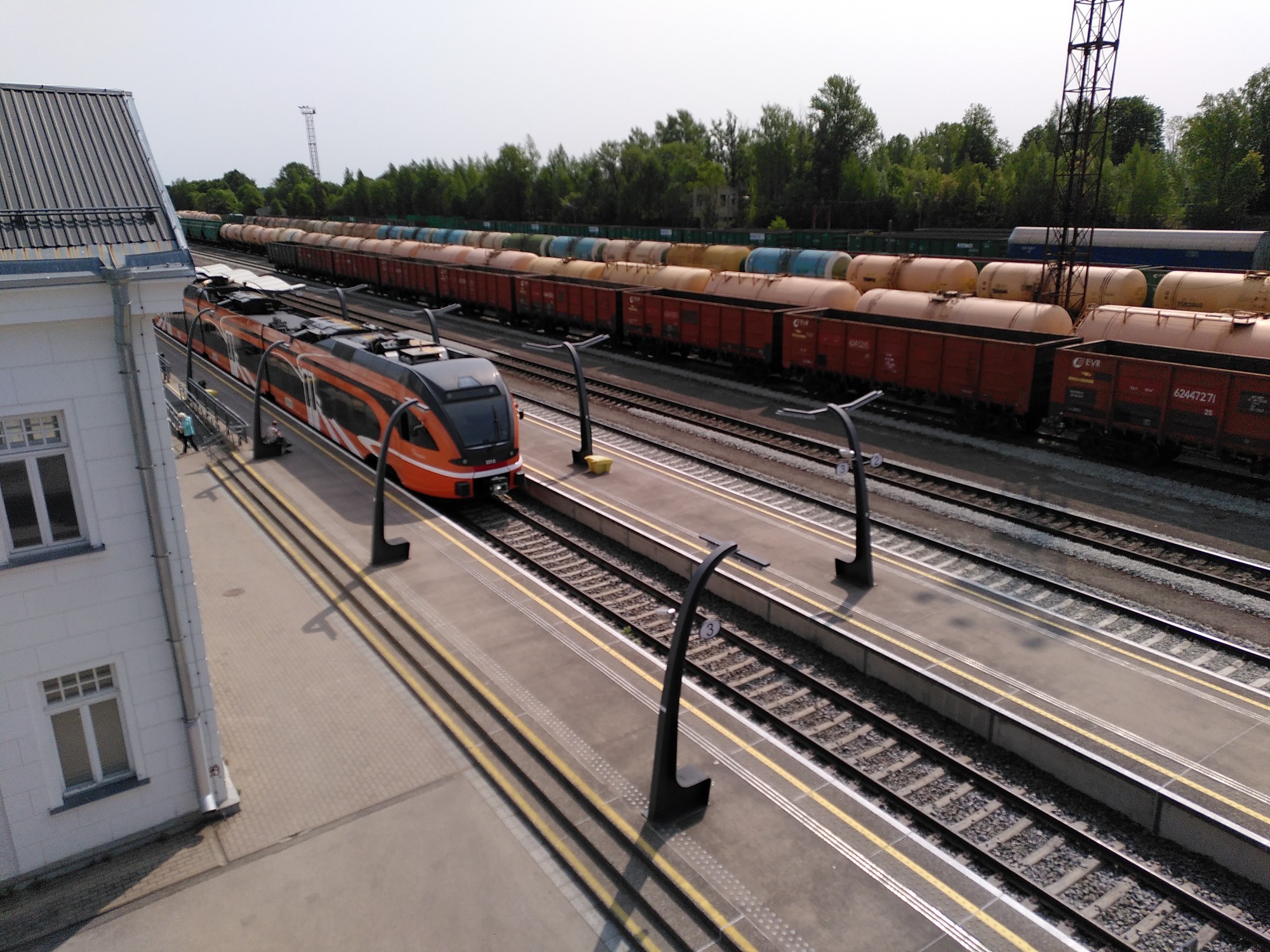
Valga station. Here the Elron train I arrived on was still waiting there.
Our arrival in Valga was punctual, leaving me with roughly four hours to look and carry my luggage around. Valga lies on the border of Estonia and Latvia, being called Valga on the Estonian and Valka on the Latvian side. I'll stick with Valga, as this is the name of the train station and I did not actually make it all the way to the border on foot, meaning that I have not explored Valka anyways.
The train station is quite large, though almost entirely used for freight trains. The passenger portion consists of two platforms, the second of which is reachable by crossing directly over the tracks. The signage suggests that along these two platforms there are three tracks, tracks one and two however are the same physical track, just accessible from opposite sides. There may have been times in which a train on these would open the doors on both sides, allowing some passengers to exit onto the second platform and others to head to the station building. Said building strikes the visitor with its grand, white appearance. Someone might have had a giggle designing it this way, as "Valga" is quite close to "valge", the Estonian word for white.
Upon exiting the train I inspected the doors of the station building from a distance, coming to the conclusion that it is probably closed. Few people were walking around and no one could be seen entering the station. While taking a closer look at the unusual layout of platforms I spotted an overpass over the entire train station, elevated to an almost comical extent. From up there one has a great view of the train yard and can witness the occasional movement. Also visible are water tower like structures to both sides of the tracks. Having been up there for some time I experienced a possible reason for the elevation: The trains operating here aren't electric. Observing railway workers moving freight cars around in their diesel powered locomotives comes with the side effect of standing in the resulting fumes. Having enjoyed the view and less so the unshielded sun I headed back down.
A few days before my departure I spotted a reddit post of a park bench painted in the colours of the Estonian flag on one and the Latvian flag on the other side, presumably at the border. I was on a quest to figure out whether this bench was situated in Valga. With the border being a good walk away from the station I ventured off, quickly halted by the weight of my backpack. I gave up on the quest and instead sat down in a nice park in a few hundred meters distance from the station and played some Celeste on my Steam Deck. This would not be the last time that the Steam Deck came into action on this trip. Between the station and said park a visitor might find themselves drawn towards a sizable steam locomotive. This is used to lure tourists to some informative boards teaching about the history of Valga, which is heavily influenced by the railway.
Back at the station, still with a lot of time to spare, I sat down on one of the benches beneath some trees in front of the building. It was here that I saw some elderly people traversing the doors, which were only small when compared to the station building they were part of. So the station was open, I just would have had to use the doors. The sitting around continued on the inside of the station, with my eyes consuming part of a book chapter on human history. After that I headed back out, on the train side. The train I had arrived in had finally left, after blocking the doubly counted track for well over an hour. I had even encountered the attendant on his trip to a local store previously.
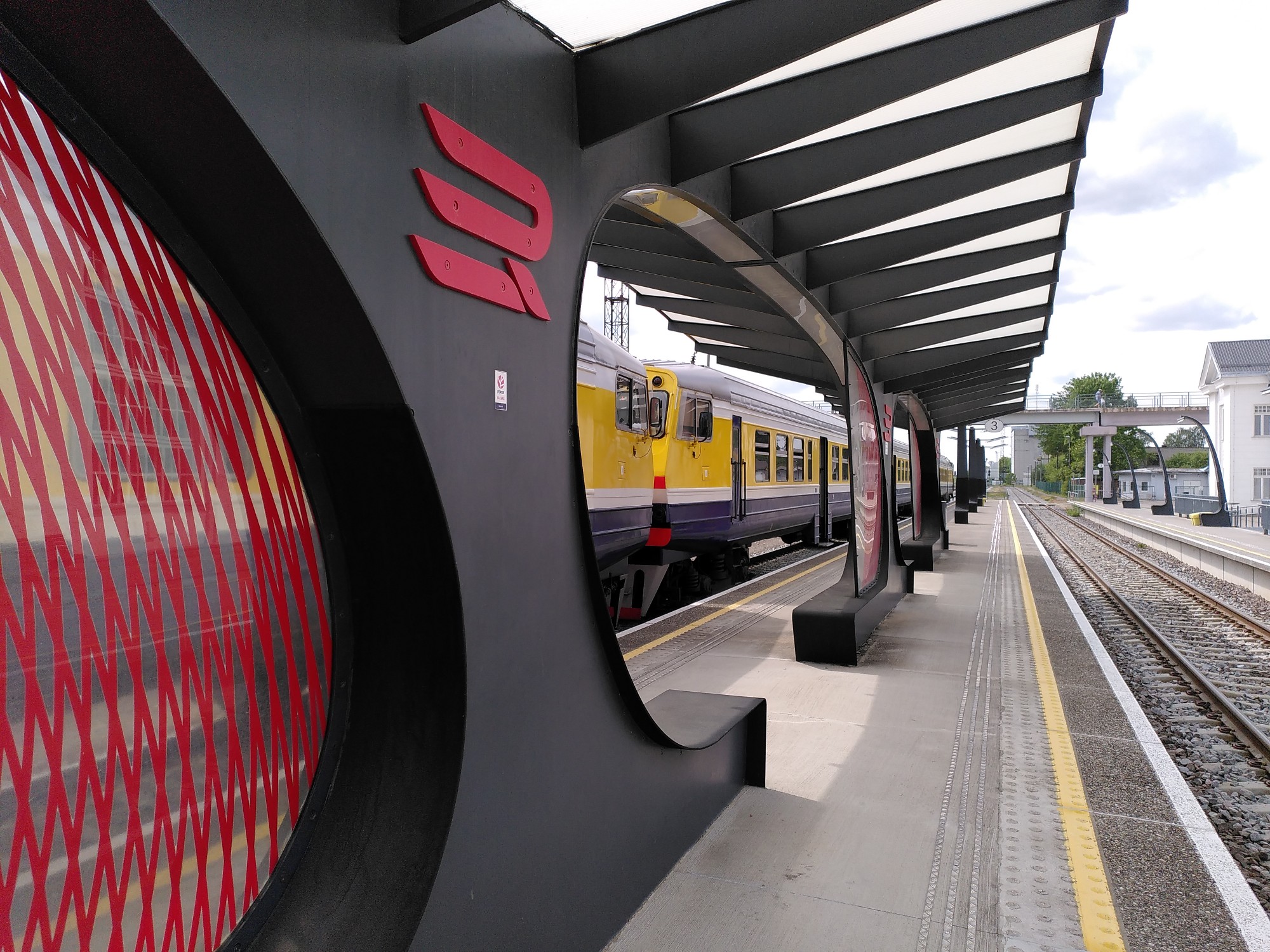
The Latvian train I took to Riga, still in Valga. Also visible are the overpass, a bit of the station building and Elron's consistent station design.
Having sat down on the platform I began sketching a freight wagon. Unfortunately the train from Riga pulled in, obstructing my view on the wagon I was copying onto paper. The train emptied a load of passengers and then followed in the footsteps of my previous unit and just stood around for quite some time. With the departure still being scheduled for quite some time in the future I wandered back onto the overpass. Here I met a gentleman from China, who had been on the same train from Tallinn and was traveling to Paris. He already had crossed through Asia by train and was now in the final days of his journey. After a nice chat he showed that there would have been luggage lockers in the station building. I will definitely have to come back there at some point to pick up the bench quest again.
Trains in Latvia
We had spent enough time chatting that it felt appropriate to enter the train headed back to Riga. This train made for quite the contrast to the modern Elron unit. Loud diesel engines, individual wagons, steep stairs at the doors, windows that can open and the list goes on. The outside appearance is striking. Standing next to this train one almost feels insignificant, as it towers over you. The colours, various shades of white and grey accompanied by yellow and dark blue don't feel unique, but very railway. Walking along the train and peeking through the windows it appears that each wagon has different seats, or at least different seat colors. Once boarded you find out why. The seats look like they were taken out of an old coach, with each aisle seat being slided as far as possible, leaving unfamiliar voids between neighbouring seats. The two rows facing in different directions adds to the oddness of this sight.
My new friend noticed the lack of power outlets on these seemingly ancient trains and used my power bank to recharge his phone. In the meantime we had opened one of the windows and got moving. While the Latvian railways have a rather nice website allowing for online purchase of tickets, most travelers seem to prefer to buy theirs on the train. This is despite the generous policy of allowing the customer to take the next train, if they missed the one stated on the ticket for whatever reason and a ten percent discount on online tickets. One reason for this might be the complete lack of WiFi on this train. With the tickets from Valga to Riga being around five Euros, less than a third of what I payed to get to Valga, this seems excusable.
Along the way our train picked up more and more passengers. At some point they even started sitting on the seats on the left side of the carriage, facing backwards. This is where traveling to the terminus comes in handy. Just sit there and do not worry about getting out of your seat with people in the way. At the final station everyone leaves and so can you, peacefully. On the way to Riga I had gotten rather tired, occasionally dozing off on the train. So my activities for the evening where limited to parting with my new friend for good - He would take an early bus the next morning to catch the train to Poland the same day -, heading to my hotel and booking the tickets for the next day. The plan ways quite complex, due to a lack of train services between Latvia and Lithuania. Previous research had pointed to taking a train to Daugavpils, transferring onto a bus over the border and then taking a train to Vilnius. There was one problem with this plan: I could not find any suitable bus from Daugavpils. The trains there also weren't exactly frequent. After a lot of searching I ended up with a different route, which only included a train because that was my plan for this trip, taking the train.
Since I hadn't eaten anything since leaving Tallinn, I appended my plans for the evening and got myself to go to some restaurant. I ended up at Restaurant Rosemarine, where I was served a nice meatless burger and some sweat potato fries. Combined with the Gin Tonic I had ordered this was enough to ensure a quick falling asleep. The next morning I tried to enjoy the breakfast. I do not recommend getting breakfast at ibis Riga center. It is entirely in the basement, the buffet is separated from the seating area by a winding hallway and some guests decide to use the coffee machine, filling the entire room with loud, unpleasant coffee bean grinding noises. That done and checked out of the hotel I headed back to the train station. A common theme on this train trip.
Riga central station currently sees extensive construction works. This is one of the places where you can actually see Rail Baltica being implemented. This also means that navigating it can be tricky. At least I think and hope that this was the reason for navigating the station being tricky. It felt like pure chance that I ended up on my platform by just following some tunnel. The tunnel was labeled, but only with a tunnel number, not the platforms it allows one to access. The platform itself was cut in half by the construction fence. One thing that delighted me was the complete ban on smoking at the station. From Germany I am used to every platform having smoking areas, which might keep the smokers contained, not however the smoke itself. Unfortunately the announcements and signs informing of the complete ban of smoking do not seem to have an effect on smokers at all…
With a similar color scheme but much more train like seats, an electric train pulled up. This one would carry me to Jelgava, in about an hour. With a refreshed mind the scenery had new appeal and this hour was over in no time at all. Jelgava, which is located south of Riga but still firmly inside Latvia, appears to be another significant freight rail station. Probably dozens of tracks line the station, with only one or two having a platform for passengers. My transfer here was not four hours and so I did not explore much, in fact only the path from the train door to the front of the station, where my next ride would show up in roughly half an hour.
That's not a train
A few minutes late, a flixbus appeared, coming from Riga, where I had been earlier, and headed to Warsaw, passing by Kaunas. My plan was to go to Warsaw, but not by bus and not that day. This bus only took me from Jelgava to Kaunas, crossing the second border of the trip.
I don't really enjoy taking long distance busses. This one was a good example why. The scenery is bland, highway with a scent of gas station. The ride is less smooth and I always feel like they aren't exactly following proper safety procedures. At one point during this trip we stopped at the side of the road and the driver and his flixbus jacket wearing counterpart talked a bit before pulling some card out of a machine and inserting another. The same driver as before continued to drive. Whatever they were doing, it was not particularly confidence inspiring. Another thing I dislike is flixbus just departing whenever it is convenient for them. The bus arrives early? You better too. To not have to think about all of this I continued playing Celeste, actually getting to the credits, which was a pleasant surprise. Even so, our arrival in Kaunas was not a minute too early for my taste.
Kaunas
In Kaunas, the major city in Lithuania besides the capital Vilnius, I once again headed straight for the hotel to refresh myself and book the tickets for the next day. I'll leave out notes on food, as there is nothing really to note here, I wasn't particularly adventurous. Booking the tickets for the next day proved challenging. There is one train connection every day, from Vilnius to Kraków, passing through Kaunas and Warsaw, among others. Other than at the Estonian-Latvian border this train is actually intended to be a connection, even with the change of trains at Mockava. As such, you can book the entire trip with just one operator, in my case the Lithuanian one. The issue was that the train for the next day was completely booked out. This presented me with the option to either take a bus to Warsaw, like the one I had just gotten off from, or wait another day. Not particularly keen on spending hours on a bus on Polish highways I opted to spend a day in Kaunas.
For this day I set myself a task. Explore the city on foot, without looking at the map on my phone. This I hoped would lead to me stumbling across things that might not have sparked my interest as an icon on the map.
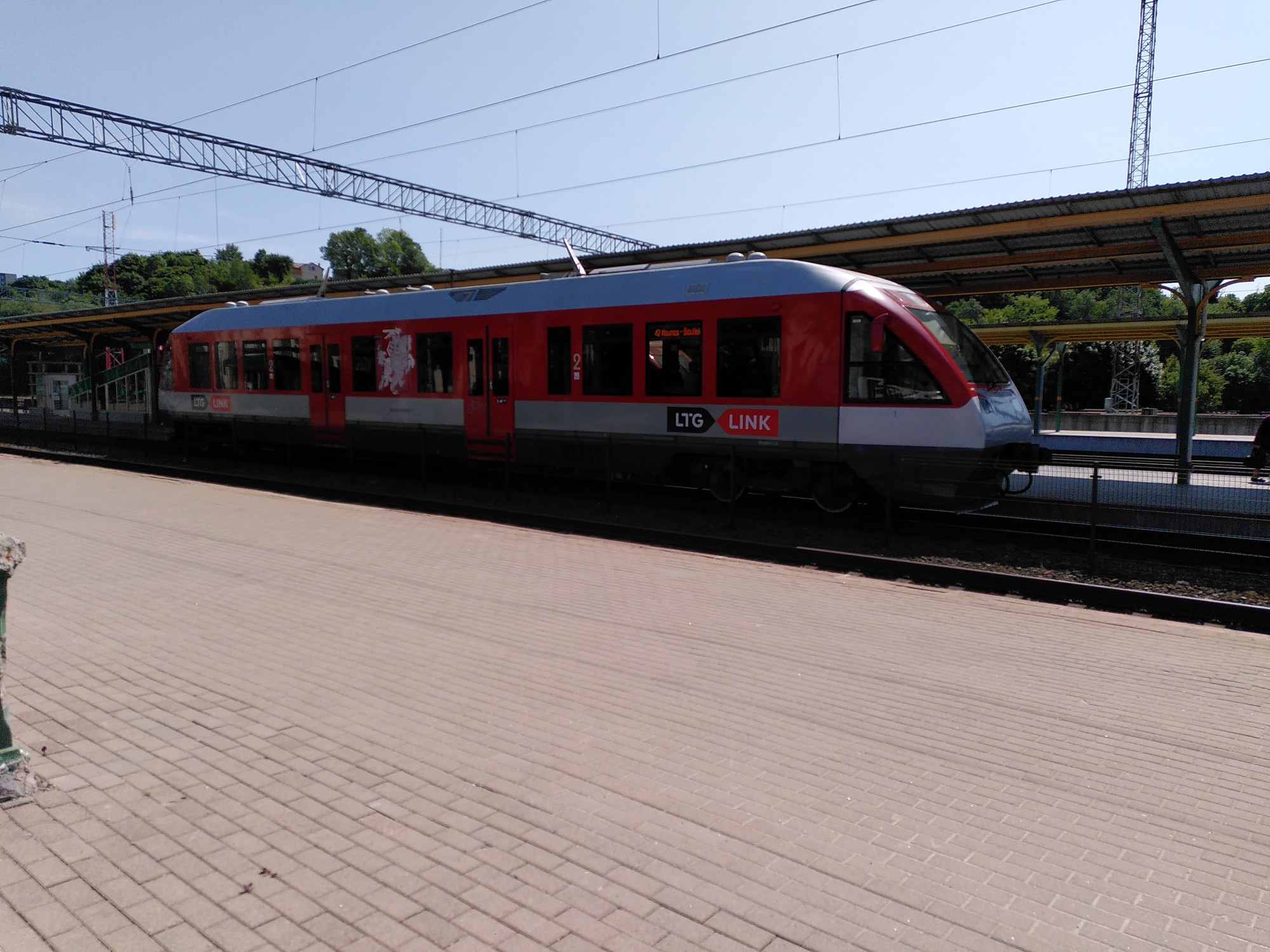
Most of the trains at Kaunas station were this cute.
I began by walking down the street towards the train station, mostly to orient myself and get a feeling for the distance, so that the next day everything would go smoothly. The station lies at an intersection, with the pedestrian crossings underground. These tunnels lead all the way to the platforms, so that I never got to see the inside of the grand station building. Everywhere the branding of the national railway operator can be found. The building has a massive LTG Kaunas sign on the front facade, the trains have LTG link and LTG cargo logos on them and so on. While wandering about the station I noticed that most trains were pretty small, cute almost. A notable exception to this was the somewhat frequent service to and from Vilnius, operated with three double story cars and filled with quite a few passengers.
While sketching another freight car I noticed one of these Vilnius bound trains departing and disappearing into a tunnel. I had expected Kaunas to be geographically plain, just like the rest of the lands on this trip. I am used to the plains of northern Germany and by now also the level nature of Estonia. On my previous travels through these countries, by bus, I did not notice any significant hills. Any yet, Kaunas truly is hilly, giving the railway a reason to disappear into a tunnel, without visibly declining.
As I had been taking pictures of scenery and more so trains throughout the entire trip I was really intrigued to take a picture of a train halfway in the tunnel. This would have necessitated two things, a nice spot to view the tunnel entrance from and the luck of getting a train to pass through while I wait. I took a brief look at the timetable, made a long forgotten mental note of the next departure time to Vilnius and got to searching a spot to view the tunnel. This search started with me going up on the conveniently placed overpass which is in serious disrepair. This was no place to view the tunnel, still to far away for my phone's camera and the view in that direction was obstructed by a pair of massive pipes running along the overpass. Some people had decided to one up those who sprayed various things on the first pipe and left their marks on the second one, in only a few places. From the station on the right side I exited the overpass onto the side of a mountain and followed steep and narrow neighbourhood streets until I came across another path leading towards the tracks. This one was blocked off with a fence, and so I decided not to follow it, a decision some other people did not agree with.
Having given up on this side of the valley I crossed the overpass once again, this time onto the other hill. Following an elevated concrete staircase I got to a memorial point. Here people had watched as their family members were deported by train. Consequently there was a view on the train station, not the tunnel though. And besides, it would have felt and been inappropriate to use this emotional place for something so trivial as taking a mediocre picture of a train. So I ventured on, through a more wealthy neighborhood on top of this mountain in the general direction of the tunnel. Instead of a view on the tunnel I came across a football stadium, right next to a massive oak grove. If it were not for the football stadium this would have been a really nice and enjoyable place. Descending the mountain along yet another construction fence I reached a major road at the bottom of the valley, which I followed back towards the train station. The tracks were no longer besides the road and therefore must have already entered the tunnel. And indeed, I reached the portal, separated from me by a road with heavy traffic, a fence and some buildings. I would not get a picture of a train in that tunnel opening, especially as the one I had taken note of had long departed.
The previous day, when entering Kaunas by bus, I had noticed a peculiar sight. Between the trees covering a mountain there were train tracks, straight up the hillside, with a passing point in the middle. A funicular. This was on the list of things I wanted to take a look at. I remembered that I had seen this just before the bus passed over the river, so all I had to do was find the correct bridge and look around that. Passing by the central bus station I ventured off into the general direction I assumed the bridge to be in. I actually got to the river and crossed onto an island in it. There were a lot of pedestrians on this island, enjoying the warm weather. (I was not enjoying the weather and very glad that I brought a bottle of water.) At the end of this long island there was a construction site for presumably yet another stadium and a bridge back onto the site I came from.
By now I had identified the next bridge as probably the one I was looking for. Held up by a series of towers with a steady stream of busses, both short and long distance, crossing over it. To reach it I followed a path at the side of the river. At roughly five meters lower than the street it is right next to the water, though still a few meters above it. Occasionally I crossed through the flow of cyclists which are definitely the dominant species on this path, to enjoy the view. Here it became apparent that the island truly is such, dividing the river in two, with boats traversing on the far side. Having reached the bridge, I got to crossing on one of the narrow pedestrian paths to either side of it. This is an interesting exercise as the paths snake around the towers, seemingly added only as an afterthought. With cyclists using the same paths and the view blocked by the towers every corner can bring either an empty stretch or a moving obstacle with it.
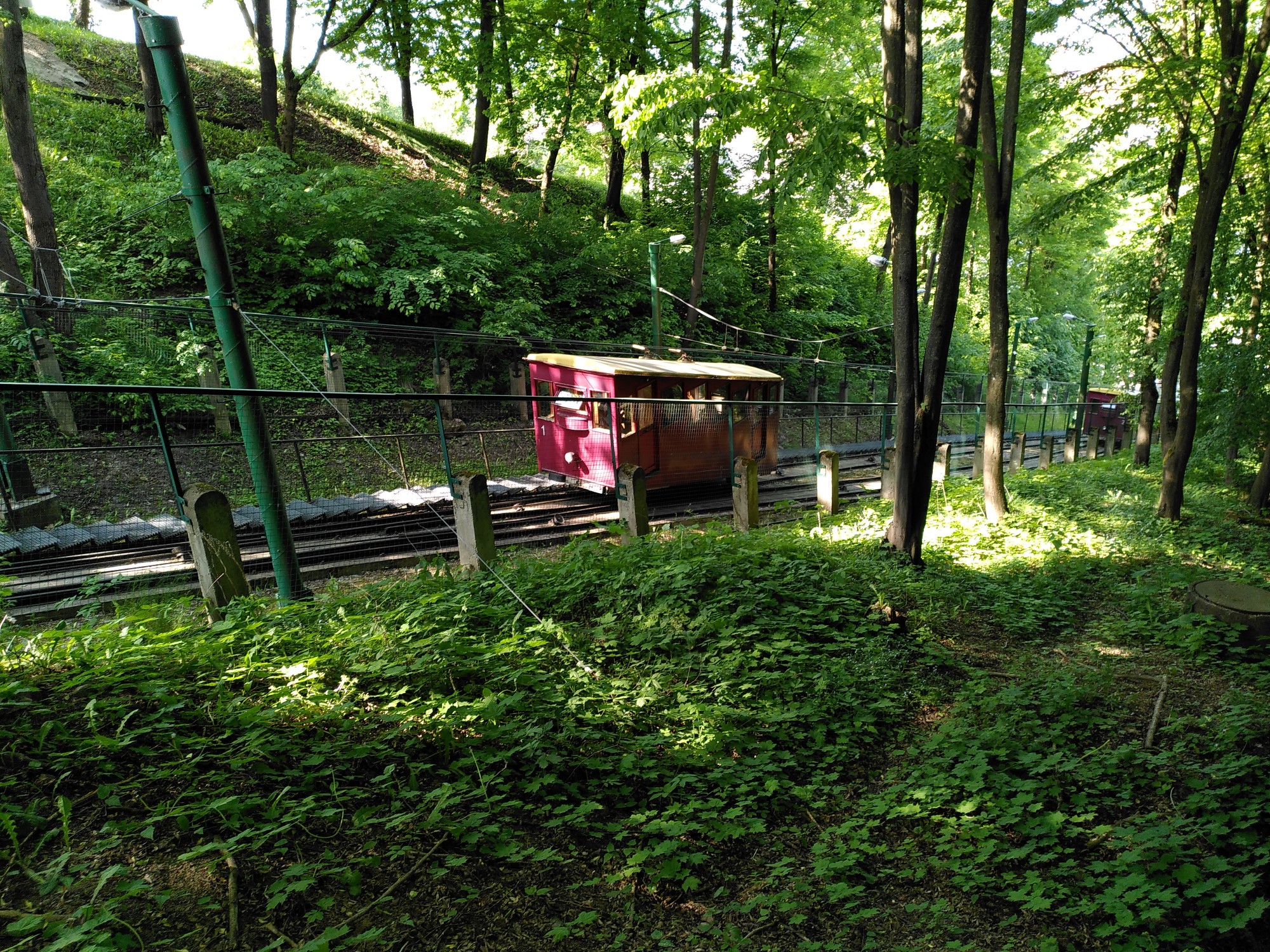
The funicular at Aleksotas hill, Kaunas.
On the other side of the river I quickly found myself on a rather unfriendly intersection. To make up for this I also got the see the funicular operating. I was in the right place, at the right time. Going up to it I debated whether to take the touristy train or the stairs right next to it. The stairs would be faster, independent of the timetable and did not cost a Euro to take. So naturally I got onboard the car waiting at the bottom and paid the one Euro fare to the operator, parting with my last coins of notable value. The interior consisted of a series of wooden banks facing inwards, with a sloped staircase between them. The amount of stairs doubtlessly disqualifies this as accessible infrastructure, meaning with maybe a few exceptions it is purely there for tourists. Supporting this theory, there were tourist information signs around. They informed me that Kaunas was the last European city to operate funiculars and that what I was now standing on was the Aleksotas hill. The view from up there was great, though nothing stunning. It was here that I realized that I had only walked through a tiny fraction of the city and probably missed the actual center altogether.
Undeterred by the heat and limited success of "exploring the center" I ventured on, but only after taking the stairs as well, for some outside views of the carriages. The top of Aleksotas hill is a residential neighbourhood, the construction of which supposedly was facilitated by the railway replacing less than two hundred meters of stairs. I followed the hill in the general direction of my final point of interest which I had seen from my hotel room: A railway bridge. It was up here that my mood was brightened by a comical sight, a grass mowing robot stuck on a rock. Chuckling I continued on. A left turn led me back to the river, with a sign informing pedestrians of an upcoming staircase indicating the change in elevation, if one had missed the slope of the path. Winding down the side of the mountain there was no staircase to be seen, dozens of meters of height were traversed on a ramp disguised as a side walk. At the very end, when it was already apparent, that the street not only led back to the river, but also to the uncomfortably large and busy intersection at the bridge, about two meters of stairs appeared. The slope was virtually the same as on the rest of the path.
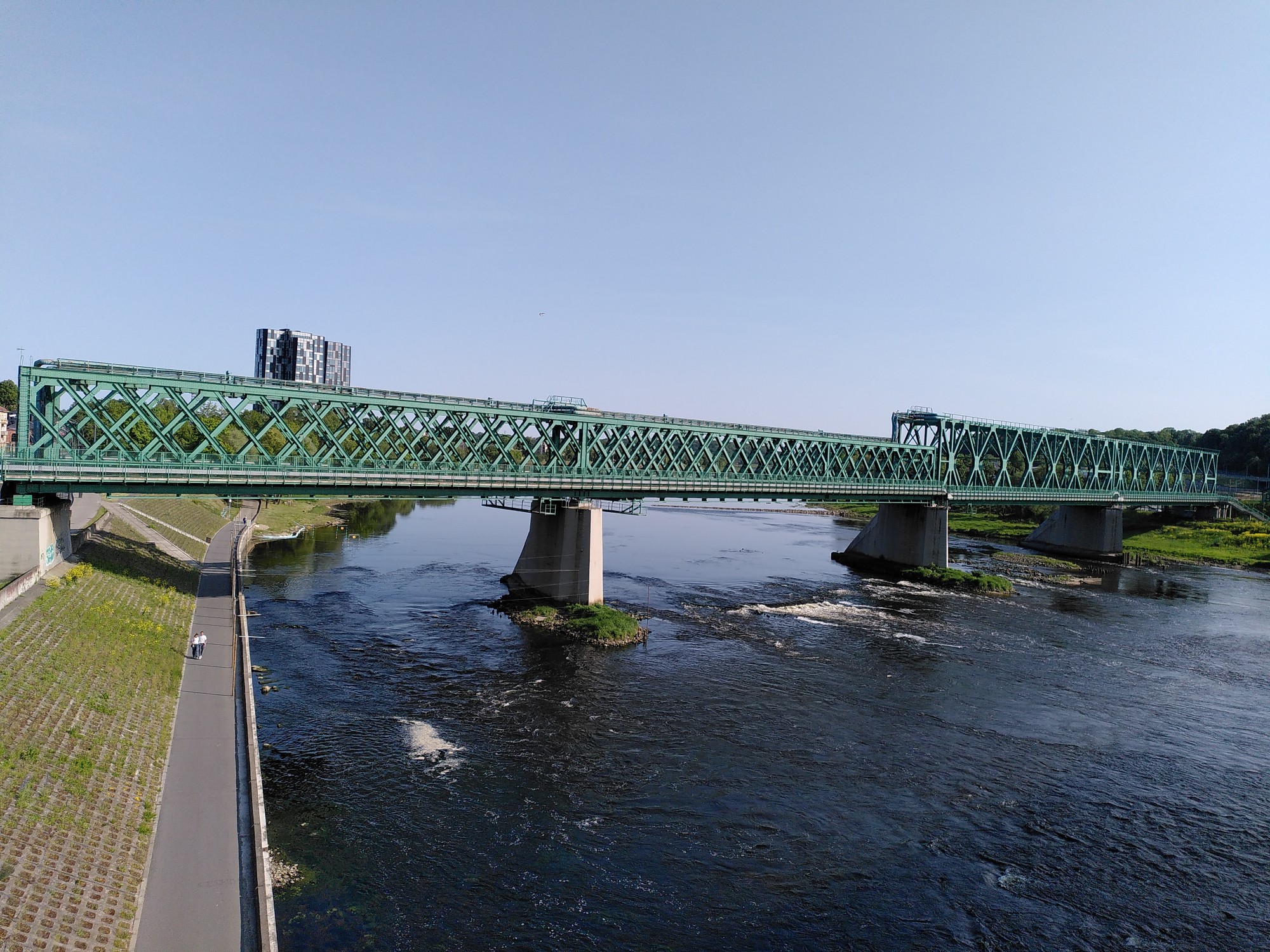
The railway bridge in Kaunas, sadly without a train.
Having already seen the city side of the river I decided to stick to the road following along the shore at Aleksotas hill. Quickly the side walk turned into just a hint of one and finally just a treaded path along the road. It took me along a construction site for what will probably be a river side resort, a few houses and then a massive industrial complex. In large letters it said "Kauno Grüdai". Without having conducted any further research I am willing to assume that this is a grain mill. At least the gigantic bag of flour displayed on a wall and the freight cars suitable for grain would suggest so. This complex started to the right of the road, away from the river, but soon took up both sides, even the railway carts could be seen on both. The shade provided by trees dotted along the path made walking there far more pleasant. Jokes on all the people hanging around on the park island, a nice industrial area was only a few hundred meters away and they completely missed out. More pleasant also meant felt shorter, after no time I arrived at the set of bridges. A modern one for cars, six lanes of urban nightmare, and the further one for trains. Green triangles of magnificence lined its sides. In the middle the entire bridge changed size, as if to allow for one half to be retracted into the other, though this probably only happened during the construction process.
As is common with urban railway bridges there was a sidewalk stuck on it, clearly visible. At every pillar it passed over some structural support necessitating a series of staircases. Unfortunately someone decided that this should be closed to the public and put multiple fences in front of the entrance. Not content with walking along the boring, loud, flat car bridge I set down below it, hoping to see a train passing over the superior one. A train did not pass by, but another pedestrian, inspiring me to check whether the sidewalk on the other side of the bride was open. It was not. Defeated I trudged along next to the cars, stopping briefly to capture the magnificence of the railway bridge. This pretty much concluded my trip around Kaunas, 17 km on foot, without a map. Would recommend.
To Poland
The next day, day four of my journey, I got back on the go. After a late breakfast I got to the station. My train was shown to be departing at platform one, track one. The previous day I had the chance to familiarize myself with the station layout and the for me unusual scheme of numbering platforms and tracks independently of each other. One thing sparked mistrust though: every train was shown to be departing from this same platform, but the train to Vilnius, distinguishable not only by the display saying Vilnius, but also the for this station seemingly unique size, was standing at a different platform. At one point a railway worker came and directed passengers to Vilnius onto that other platform, with the display being refreshed shortly after. I was still in the correct spot. Unfortunate, as there was little to provide shade on this platform.
The train pulling up was different from the ones I had seen before. Not nearly as large as the ones operating between Kaunas and Vilnius it still was longer than the tiny ones seen otherwise. The colours were reminiscent of the typical LTG link scheme, though with more gray and silver mixed in. On board it became apparent that most passengers had boarded before with few seats empty and the aisle filled with bags. The reason for that was obvious too, the overhead luggage racks were barely enough to hold a few sheets of paper, maybe a laptop. So the only place to put large pieces of anything was the aisle. Trying not to think about the lack of safety I navigated to my seat. Someone had the foresight to make seat reservations mandatory. With the seat next to me miraculously vacant my luggage did not fill the aisle. Seated at the window we set off, towards the Polish Lithuanian border.
Having served a few local stations we reached Mockava, a station near the border where we would transfer onto a polish train. A single passenger could be seen leaving the station, so there probably is more than just a train station here, though their destination was not visible. I suspect that this is where we changed from soviet style broad gauge tracks to European standard gauge, however, there was no visible difference to the untrained eye. It was not clear what track the polish train would appear on, but everyone seemed to assume that it was the one right on the other side of the platform, and they were right.
Snaking through Poland
The Polish train was what I later learned to be a typical Polish Intercity. Classical cars, pulled by a locomotive, all blue and white with the letters "IC" on them, though one could easily mistake it for "ICCC". The seat numbering on board was not exactly intuitive, with six in ten numbers being skipped, but my seat was there, almost as if someone had planned that. Out of the four wagons only two got passengers from our previous train, at least according to the wagon numbers, I did not get up to check.
We sat off, first towards Suwalki, then to the south. Poland is bigger than it seems, we went south for hours. Announcements were only made in Polish, no chance of catching what was being said. Luckily I had downloaded a map for the area around Warsaw, so I could see when we were approaching my station, Warsaw Central. The train would have continued on all the way to Kraków, but while booking I just assumed that Warsaw would be the best place to transfer. Early on we must have been stuck somewhere or got limited in speed. When the website on train delays was showing our train, it announced roughly 50 minutes of delay, due to some other track operator. Looking at the map, when we finally turned westwards we would not have made Warsaw in time at our usual speed of 130 km/h, even without stops.
Even without the delay this leg of the journey would have taken over six hours. And it would not be followed with time to rest, as I had booked a connecting train from Warsaw towards the Polish German border departing that same evening. I was getting bored of hotel rooms and would have had to get up really early in the morning, so this was an easy choice. In Warsaw I originally had a buffer of 65 Minutes. With the trip so far having had no notable delays, this seemed perfectly reasonable. We arrived 64 minutes late. My connecting train was on the exact track that we were supposed to arrive on. I had planned for this, should I not make the night train I would just sit six to seven hours in Warsaw and get on the EuroCity departing at 04:11. This train would require fewer connections and was even already noted on my ticket for within Germany as a way to get to Berlin. With a bit of planning and more importantly without any particular hurry, a train delay does not have to get to your nerves, I was having a great time, though the seat was starting to feel uncomfortable.
Someone must have thought of the connection to the night train and arranged for our Intercity to stop on the same platform. Me and another passenger rushed out of the train, got four meters of Warsaw under our feet and jumped onto the next train. Connection caught. This train would be another seven hours, the same style of Polish Intercity, even the seat looked the same. I am almost sure I could have gotten a sleeper department or at least a nicer seat, but I did not, for two reasons. Had I fallen asleep on this train I could have easily missed my station, resulting in me driving through Poland, without a valid ticket and no idea where I was. Also, booking this train was a challenge. There are multiple websites to buy Polish tickets on. One has an English version, but did not have the connection I wanted. Another, Bilkom, purely in Polish, did have the connecting Polregio train I wanted to take to Frankfurt(Oder), the German side of the border town. However, everywhere I looked, tickets over the border where not sold, only to Słubice, which is an hours walk away from Frankfurt. Using online translation tools I managed to book a ticket from Warsaw over Rzepin to Słubice, with the rest to be figured out later.
So, having just barely gotten on the train to Rzepin and sat in my seat, the journey continued as if nothing had happened. With the destination of the train laying to the North West of Warsaw it only makes sense that we first went towards the South West. After a few hours we did eventually turn North. This was the first train I decided to do some proper reading on, as the journey was going to be long, distractions were few with the windows just being black, and I needed to stay awake anyways. At some point the tickets were checked, it seemed that my somewhat blindly bought ticket was valid and I got on with the night. People on board were either sleeping or having a great time, the atmosphere was quiet, but also notably pleasant. No announcements being made during the night probably helped with that.
Every station brought a bit of movement into the carriage, with a handful of people leaving and others joining. At some point a man with a dog entered and walked towards the end of the train. He desperately tried to quiet the animal, with limited success. The young attendant was visibly amused by this, as were most passengers. Once he passed my seat I noticed the more likely reason for the amusement, a goose. The goose came with a carrying box, but was walking trough the train on its own feet. Great excitement ensued. The man tried turning around, lifting the carrying box over an empty seat. Unfortunately he also tilted it, littering seat and floor with a bunch of wood chips. No one was visibly mad, with the attendant, as far as I could tell not speaking her language, being not happy about it, but amused still. The man ended up at the end of the carriage, wich was the last one on the train and was only to be seen once, when he went to brush his teeth.
At roughly 04:00 we neared Rzepin. I got up from my seat, grabbed my bag and wandered towards the doors. Another young passenger was trying to ask me whether we were approaching Rzepin, though her pronouncination did not get close to how I imagined the name to be pronounced. Most likely a result of my imagination being entirely off, somehow even with a different number of audible syllables. After about half a minute of trying to communicate in different languages I realized what she was asking about and showed her my phone, displaying the stops for the journey, with Rzepin being the next on the list. She was satisfied and got of the train as well.
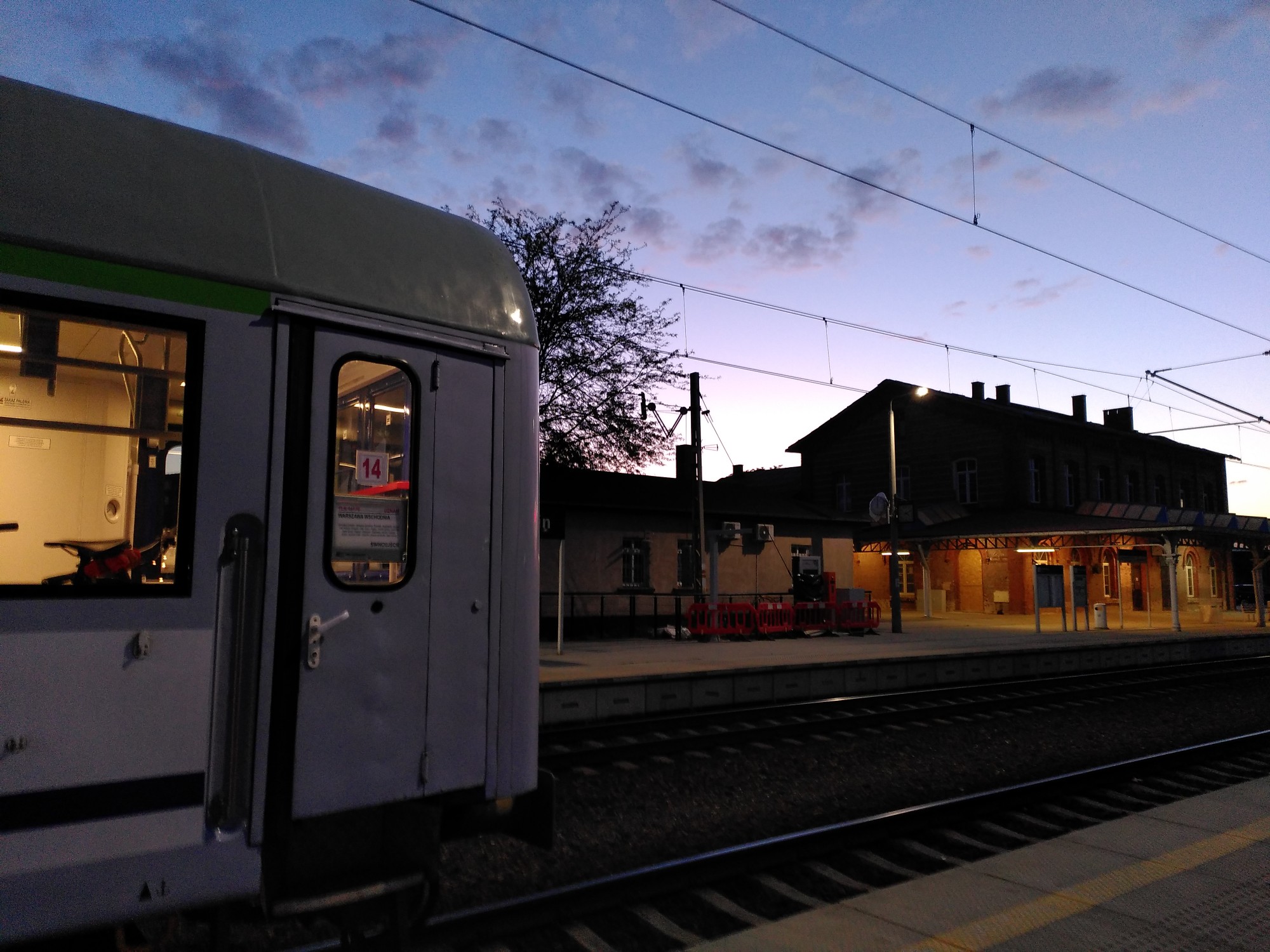
Rzepin train station. When taking this picture I had just gotten off the train on the left.
I had already noticed it through the train windows, the night sky started getting some color. The sunrise was close. A good thing as I would have to wait for more than three hours to catch the first regional train to the border. The station in Rzepin is different to the others on the journey. A small building sits in the center, completely blocked off and decidedly in disrepair. A sign still indicates that tickets could be bought indoors, but most likely not at this time of the day and not at all for some time already. In front lies a roundabout serving as a bus stop and a drop-off point for people being brought by car. The back of the building is fitted with a roof extending to a smaller building housing toilets, also blocked off. Instead a porta potty equivalent is provided at the roundabout. I considered using that, opened the door and was struck by a colorful mess and the most revolting smell I have had the displeasure of smelling in a long time. I closed the door quickly enough to not even register what was on the inside, all I remember is it being a colorful mess and not the shape this facility should have. With no running water to be seen anywhere I washed my hand by thoroughly swiping it with a paper towel I brought, hoping that this was enough.
To both sides of the building there were platforms and tracks, on one side even with an underpass. This was not the side my previous train had arrived on, nor would it be where my next train should appear.
I spent some time trying to get a ticket to Frankfurt(Oder). The bus stop had a ticket machine selling train tickets, though not over the border. I sat down and checked the website of Polregio, no success, VBB, no success. I would have to buy it on the train or would face the walk. With this my options for things to do about this were exhausted and I wandered around the station, taking pictures of the many freight trains that could be seen. Even this did not fill three hours and so the Steam Deck saw some more use.
Nearing the time my train was scheduled to arrive a bus pulled up, with some Polish announcement containing the word "Berlin" being made. The announcement was probably for the train from Berlin that also arrived so I did not investigate the matter further. Finally, my train arrived, with a bunch of people leaving. I got on on one end and started walking towards the other, hoping to find the attendant to buy the necessary ticket. I did find him, as much as he found me, as he was walking in the other direction. The rest of the train was empty. In Polish he tried to inform me that the train terminated here and I should take the bus. I asked whether he spoke English, he did not. As he was clearly signaling me to get off the train, I did. Out of options I got to the bus and asked the driver whether he spoke German. In German he did reply that he didn't. That was followed up by saying Frankfurt and signaling to the door. I handed over my bag and got on board. The second coach on this supposed train journey. The attendant from the train got on board, looked at the handful of passengers and sat down. Once we departed he wandered through the aisle to check the tickets. I showed mine, saying in English (I do not know why, after all I already knew that he did not speak English), that I could only book up to Słubice and would like to go to Frankfurt. Seeing my predicament he tipped on his phone and showed me the screen, displaying a ticket from Słubice to Frankfurt. I pulled out my credit card, hoping to be able to pay the four zł with it. Of course this worked, this was no German bus after all. His printer got to work printing the longest ticket, roughly 15 cm, of the journey, for the shortest distance, one train stop. Holding this last puzzle piece I sank into my seat, relaxed. I would not have to walk.
Germany
After a few stops the bus crossed over the border and entered into Frankfurt(Oder), where everyone got off at the train station. Nothing particularly glamorous. A few tracks above a hall with an assortment of shops and actually operational toilets. I did not check how operational they were as handling coins to use them seemed like too much effort. On the tracks I saw another blue Polish Intercity, headed towards Berlin, though not the main station. My ticket from here to home had this one on it. As it was a flexible ticket I could choose any train in the general direction and decided to instead take one leaving earlier and stopping at Berlin main station. Once departed we quickly reached a smooth 160km/h, speeds not seen before on this journey. This was a regional service operated by ODEG. The seats are rather comfortable, though they obstruct a lot of leg room. The ticket inspector was of the kind that can only be found near Berlin. Loudly and friendly he explained to some other passengers why their ticket was not valid yet and that they had to write their names on it. A minute later he checked on them again, satisfied with the result. After seeing my ticket he asked me to present the DB discount card I had used to buy it. I noted that this was the first time anyone actually asked for that while looking for it. His response: 'You paid good money for that, so you have to make use of it!'. This train was a pleasant experience.
Calling Berlin main station (or "Hbf", Hauptbahnhof) a railway cathedral is almost an understatement. Thanks to two different stories with tracks trains can depart in any direction. Between these stories there are more, filled with shops of all kind. The open architecture presents the traveler with a stunning view of walkways, staircases, trains and elevators. And yet, I have seen train stations with three tracks that were more confusing. In Berlin I had my usual Cheesebretzel and got to my next train. The DB Navigator app predicted medium ridership. Leaving Berlin main station the crew had to make an announcement on where to find the last open seats. Thanks to my seat reservation this ride on Germany's flagship train, the ICE was pleasant, despite the crowded nature.
In Hamburg I transferred onto another ICE, with the same exact experience, only to quickly disembark at Bremen, with the train continuing all the way to Switzerland. One last change in Bremen onto a less crowded Intercity and the journey was basically over, with no more note-worthy occurrences.
As a final note: When traveling in Germany, avoid connections with a change of trains at Hamburg main station. The only time I have not seen it entirely overcrowded was on a late Tuesday evening.
Tallinn to Germany by train, mostly © 2023 by Andreas Hurka is licensed under CC BY 4.0
